Sunday, October 3, 2010

The Empress


On an overcast Sunday morning it's a good thing to sit on my couch while thinking of sunnier days... and listening to Linda Ronstadt's Lush Life album, in which a good singer grew up and became a fine singer- with the help of Nelson Riddle and his orchestra. Lots of great session work for her to play off of. I love these old songs, the sentiments, the melodic richness, the jazzy harmonies, the room for improvisation, the insights into the human heart. Rock and roll and its spawn put an end to such art. How sad for recent generations that they have lost so much. I expect that someday soon the last half of the twentieth century will be recognized as an era when our cultural values lost their moorings. Sometimes it embarrasses me to live in this age.
Somehow the idea that beauty has a truth of its own has been displaced by the idea that beauty is kind of a lie. That is to say the real truth is that there is no truth, according to contemporary conventional thinking. It's a philosophical viewpoint that's been a long time in the making, taken up by artists in the late 19th century but it did not take hold among the general public until the '60's. It seems to me that World War One was the tipping point. As one of the most brutal and senseless wars ever fought it seemed to prove that the belief in an enlightened and civilized western civilization was nothing but a fable. Artists like Picasso depicted a fractured world, torn apart, and implied that this was its true nature. Science likewise undermined two thousand years of faith in a benevolent creator by contending that the world just is, and that's all there is. This, of course, leaves no room for beauty, nobility, love, purpose. Once it is accepted that this one life is all we have then it is just as Paul Johnson says in his Quest for God.
"If on the other hand God does not exist, another momentous set of consequences follows. This life then becomes the only one we have, we have no duties or obligations except to ourselves, and we need weigh no other considerations except our own interests and pleasures. There are no commands to follow except what society imposes on upon us, and even these we may evade if we can get away with it. In a Godless world there is no obvious basis for altruism of any kind, moral anarchy takes over and the rule of self prevails."
Luckily Victoria preserves physical reminders of a time when beauty was a goal of architects and planners. It wasn't enough to be utilitarian, to merely let form follow function. Form and function have always been a necessary prerequisite to successful buildings. After all, they aren't supposed to crumble or fall down, they must shed rain, every element must work as well as possible. But that is engineering. To be an architect of note a sense of beauty and proportion had to be cultivated. In the 19th century that meant a knowledge and familiarity with classical forms.
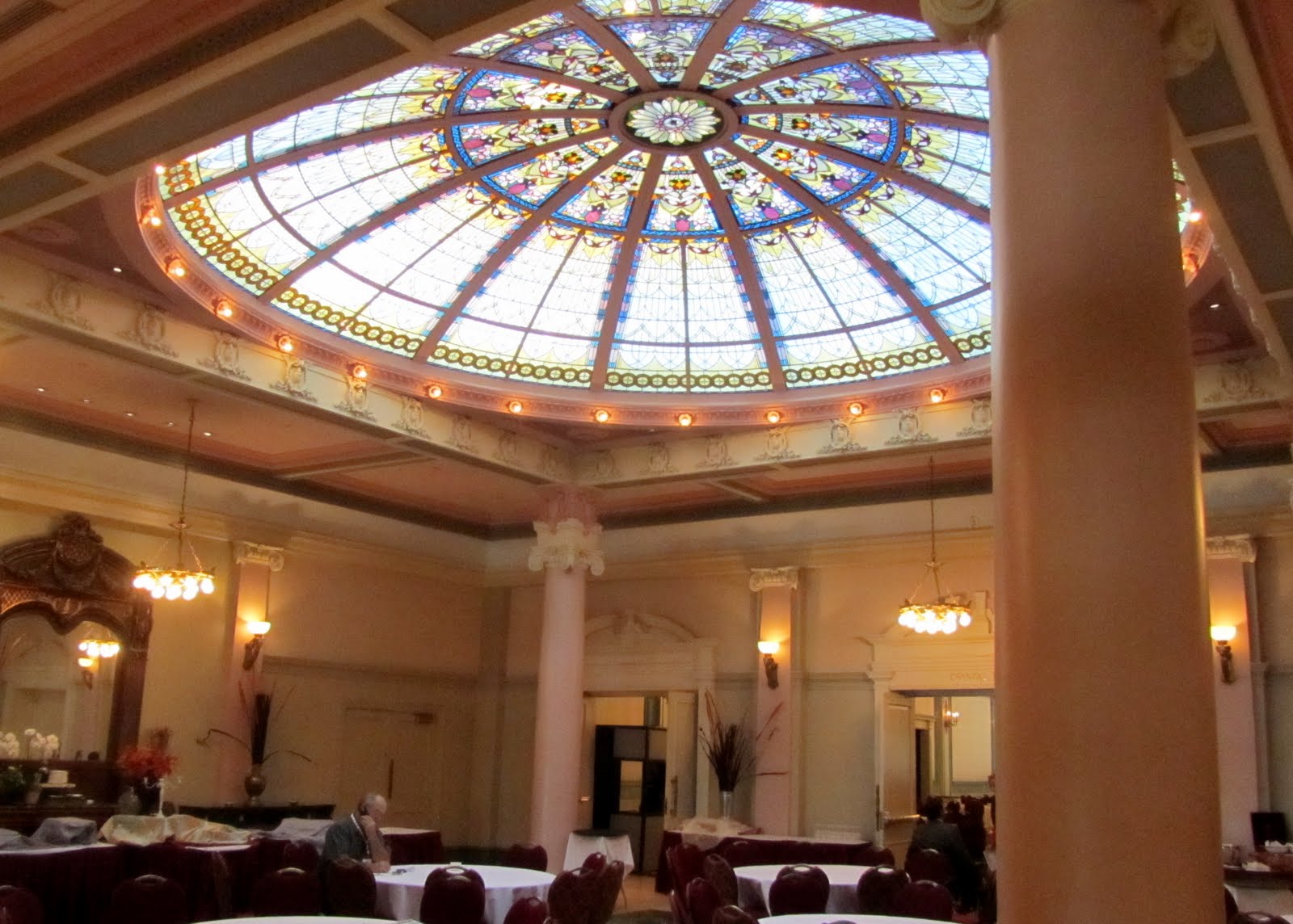
The Empress Hotel is a fine example of 19th century ideals, and unlike music which is rather ephemeral, stone is quite durable. Along with Parliament it frames the Inner Harbour in a composition of pure harmony and proportion. Why do so many from so far away trek into Victoria to see this vista? It's because despite all the propagandizing against beauty in our lifetimes, we retain a craving for it. Art is not just a repetition of nature, or an arbitrary outburst of an artist's 'feelings,' it is an expression of a man's striving to embrace a truth that cannot really be found on earth. A work of art brings into the material world a vision the artist has of a higher and deeper world, one to which we are all sensitive, but to which the artist has a special relationship. It raises all of us.
To a utilitarian peaked towers and stained glass skylights are nonsensical. Think of the maintenance. And isn't English ivy an invasive species? But then on the other hand if you are trying to sell a piece of art carved from mammoth tusks and BC jade for $76,000 then somehow a flea market on the street won't do- high ceilings and brass fixtures make a far better setting. Oh, well. On a fine autumn day I'm glad that much of Victoria was built before the world went insane. And try as they might the prophets of soulless ugliness have not been able to stamp out that human spirit that aspires to beauty. Even the activist on the corner can't hide her prettiness behind the scruffy look that is today's idea of fashion.

Friday, September 24, 2010

Reflections on Middle America


Back in Victoria where the autumn rains have had an early start, I thought I would be in a reflective mood about the parts of the United States I travelled through. Instead, all I wanted to do was sleep for a few days and vegetate in front of the TV, my mind a complete blank. The biggest problem with the trip was that it went by so fast. I have a friend from England who likes to point out that Europeans have no concept whatsoever of the sheer size of the American nation. Any country in Western Europe can be crossed by a fit cyclist in a few days. I nod in agreement only to discover I also did not comprehend the distances between the Pacific and the Atlantic coasts.
Not only are the distances vast, so are the differences among the regions. Areawise, Canada is even bigger than the US, but Canada is largely uninhabited. Only on the prairies do large population centres extend to the north, all the rest of the country strung along the southern border. Canada is what's left over to the north after the best and most productive parts of North America became the United States.
Which country has ten times the population of Canada. And whereas very little of Canada is populated to any degree, almost all of the lower 48 have thriving and diverse populations, many parts of which have long histories of settlement. While Canada is like a string of lights along the border, the US is like a doughnut. The most populous areas along the coasts and the Great Lakes, and a largely empty region in the middle, which only thrive because of works of hydraulics... rivers be dammed.
So the distance I experienced between Victoria and eastern Nebraska was of a greater magnitude than I imagined while contemplating the roads drawn in my maps. It was too much for me to absorb. Every area, to be properly experienced needs weeks at a minimum. Time is needed to meet people, to explore the byways, and get a feeling for it. Just watching the landscape flash by, even when I can keep the pace down to forty or fifty miles per hour, is absolutely insufficient.
Nevertheless, I'm glad I did it even if it just to learn that lesson. I also learned that I am a confirmed dweller by the sea. The wild and dry hills of Wyoming are beautiful, and so are the cornfields of Nebraska, but after a while I craved the sight of a green forest.
This November is shaping up to be a historic month in the US. It appears that a political sea change is taking place. For decades the elites in the cities and academies have imposed an alien rule on what is called Middle America. Middle America refers not just the people who occupy the middle regions of the country, but the productive classes in every part. While ordinary Americans have been busy 'doing the chores,' these elites have been undermining the foundations of the country. Now Middle America has had enough. A movement called the Tea Party has grown out of the American soil to take back their country from these usurpers. I rather wanted to be there for the Nov 2 elections but I will be watching and cheering from the sidelines.
But I would like to remind Americans that Canada went through something similar several years ago, when our arrogant governments tried to turn western Canadians into second class citizens. First we voted down a referendum on the matter, and then we virtually destroyed the party that sponsored the program. The Reform Party took its place, and unfortunately there were a bunch of pretenders, opportunists who saw an opportunity to jump on a bandwagon but who had no loyalty to the principals behind the Reform Party.
I'm sure the same thing will happen to the Tea Party, so keep your knives sharpened Tea Partyers. You will have to do some pruning after the first battle is won. But I think many Americans know that. They have paid for their freedom with their blood and I don't think they are going to roll over now.

Sunday, September 19, 2010

Midwestern Cornucopia


Dateline Puyallup

I've had enough of the open road, and have curtailed my little adventure. After a lovely drive through the Black Hills I spent two days traversing endless fields of corn- not the kind of corn that you buy at the grocery store, but the kind that is fed to the beeves, or turned into corn syrup for your candy bars, or alcohol to fuel your car- I was in a daze. South Dakota and Nebraska are but two of the states in the midwestern America that exist to feed the world. Much of Nebraska is composed of an area called the sandhills. These are grassy knolls aplenty, sparsely covered with grass where the beeves graze not knowing that the feed lot awaits them, and that it is their fate to transformed into Big Macs. Buffalo formerly roamed here, pursued by Cheyennes, Hunkpapa, and other indigenes. Now placid kine have taken their place, having made a grim bargain with modern man. They have traded the uncertainty 0f wildness for the certainties of domestication. Has it been a good bargain? There are millions of cattle now, but very few buffalo.
Along the Platte River trundle trains after trains loading from the silos, elevators, and feed lots bringing the products of this cornucopia to the cities. This is the industrialization of food, and without it, the cities could never support the populations they take for granted.
But it is a long way from the wild paradise described in George Armstrong Custer's diaries, and hurtling along the highway one is consumed by a hunger to see hills and mountains, valleys and canyons and cascading rivers.
Those indigenous people were displaced by my people, and that was what I came to see. Now I have seen it, I am glad, and now I want to see the ocean again.

Tuesday, September 14, 2010

Little Bighorn


"Why hop ye so high, ye high hills?" is a biblical quotation that sticks in my mind, though I don't know which part it comes from. It came to mind again as I stopped at a turn off and gazed up at the barrier of the Bighorn Mountains. Out of Cody, my next objective was to see the Custer Battlefield, and I chose the 14A route because it looked like a shortcut. It turned out this range of mountains that- compared to the Rockies- didn't look like much on the map. But there it was, a line on a mountain side, and the second thought I had was, "That can't be the road." But it was.
Cody is about 5000 feet high and the floor of the plain below the Bighorns must be about the same. So within about a half hour I had reached the summit at 9000 feet. I feared for my poor little van, but she didn't make the least complaint. The road runs along the top of the range and then plunges down on the other side.
I took a liking to Wyoming. The people were friendly, the houses neat and tidy, remnants of the old days were well looked after, and the countryside is beautiful. Cody is a bit touristy, showing off its cowboy heritage, but I liked it.
Wandering around the site of the Little Bighorn battle where an unwise George Armstrong Custer led his men to their deaths I got a chill, even though it was a hot day. The site has a museum and gift store. Talks are given by Park Rangers about that famous event. Admission is $10. The grave markers are placed where bodies were found, and though the biggest concentration is on that hill, many more are scattered all around.
Over the years, how this event has been interpreted has undergone many changes. In my youth it was all about the bravery of the soldiers. More recently the trend has been to find fault with the treatment of the natives by the invading whites. The implication of this latter view is that a cordon sanitaire be placed around a vast area of the West where they could continue to live in blissful harmony with nature, chasing the noble bison, roaming freely on their ponies, forever and ever. This is obviously nonsense.
Among the Hurons in Ontario the Jesuits had already tried to prevent them from being corrupted by white society. By converting them to Christianity, a purer Christianity than any other. Of course, they were eventually wiped out by the Iroquois, a related agricultural people.
I do have an inner environmentalist which would like to see this landscape as it was before farmers, ranchers and miners transformed it. George Custer wrote in his journal what a paradise it was for a hunter. He loved it, too. But there was no way to hold back the human tide coming west.
The Sioux, having mastered the use of the horse better than any other tribe, themselves were invaders who had taken territory away from the Crows. This is history. The first whites in the area were fur traders. Their day was already over. Then came the cattle drive era, made so famous in movies. That only lasted 20 or 30 years. One wave displaces another, and on and on. If we're not careful it could happen to us.
But having passed through this land I can well understand why the Indians did not want to give it up.

Friday, September 10, 2010

Yellowstone


I got caught in a traffic jam this morning... just a few miles inside the west gate of Yellowstone. It was rather unexpected. The Park Ranger mentioned something about road work. Still, the scenery was not hard to look at. Traffic moved at a crawl. I checked my watch. It was 9:30. Cars stretched ahead for as far as I could see, and in my mirror I could see another line snaking behind me. Finally, after almost a half hour, I came around a curve and right at the front of the line of traffic was a large brown animal in the road. Pretty soon, as the cars ahead of me cautiously passed him, I could make out what it was. It was a big-assed buffalo sauntering down the centre line of the road. As I inched past him, he rolled his head toward me and I'm glad he didn't take a sudden dislike for Toyota vans.
I guess that's the first time I've seen a buffalo in the wild. But I wasn't in Yellowstone to see bears or buffalos, or elk or pronghorns. I've seen wildlife before. But I've never seen geysers. I've never been in the caldera of a dormant but very much alive volcano before. And it's amazing. Look in any direction and you'll see puffs of steam rising up here and there, by the side of the road, or across a field. And someday the whole thing will blow up again. When it does the whole earth will shake. Millions will die. There is nothing we can do about it. When it goes it goes.
It was a cold day, so I didn't spend as much time there as I should have. I'll probably never be back, either. That rain that came down in Idaho was snow in the higher elevations of Yellowstone. But now I'm in Cody, and it may be windy but it's at least in sunshine.
Take no notice of the image second from the bottom. It really is NOT a carving of an ancient Persian warrior. This is how rumours start.

Day three


DATELINE CODY, WYOMING

Last night I almost gave up. It wasn't a bad day coming through Idaho. Oh, I got turned around briefly in Boise while trying to find my way to the highway going east, but I was surprised. My previous experience of Idaho with with the northwest corner around Sandpoint which is green and mountainous, covered with coniferous forests, and I thought the rest of it would be pretty much the same. But going south from Lewiston, it became broad, flat meadows separated by mountain spurs. The meadows were planted in crops or given over to cattle, all quite beautiful. To connect one to the next, the road winds through narrow gorges with rushing streams at the bottom.
Then around Boise the hills dry out and begin to resemble the ones in eastern Washington. I took the Interstate out of Boise- eventually- to Mountain Home and found a nice quiet route which would get me to Idaho Falls and then to Grand Teton and Yellowstone. It rained off and on but it was pretty nice anyway. I've been through places like that in the heat of summer, and cool and overcast is my preference.
The side route took me from the Boise plain into the hills where it crossed a track used during the Oregon Trail days. The biggest surprise was the area called the Craters of the Moon. When you first come up to it you can't quite figure out what you are looking at. It is a landscape consisting of heaps of black slag, the remnants of a volcanic event that took place long ago. The earth opened up and poured forth its bowels and they all turned to cinders. It goes for miles and miles, black and desolate. What feeble creatures we humans are compared to that power. Our vaunted modern mastery of nature would vanish like a silly illusion.
This is the West. It's different than the east, different than Europe, different than anywhere. It's no wonder Westerns were so popular. The landscape of the west was always the uncredited star of every great Western movie.
I can't help think of the native peoples who foraged in these areas before Europeans came. This is not meant as an insult to say that they didn't live much differently than human ancestors going back to the old stone age. They weren't able to impose their will on the landscape, they took what they could find, moving from place to place, from season to season according to the whims of nature. Only so much to eat, so populations remained small. Things were changing. One culture on the prairies farmed and built fortress towns. And then the horse came along, and the mythical image of the noble hunter was born. They were just as wild as the prairie wolves, and just as bloodthirsty. They had no use for the pale wasichu who began to show up.
But once the Old World impinged on them the game was up. If it hadn't been the Europeans, sooner or later it would have been Chinese or Arabs. Or if not, then the Aztecs or their successors would eventually have ended the bison hunt.
I meant to stop for the night on the other side of Idaho Falls on the way to Grand Teton, but this time I ended up on the road going to West Yellowstone. Oh, well, I sighed. Might as well take what comes. It was getting late. And then the skies opened up. It poured all night. I couldn't find a campground in the dark and so I parked next to a paint store in Ashton and spent a miserable night. This morning the rain had stopped but I very nearly turned tail and went home. I'm getting too old for this.
But here I am in Cody, and Yellowstone was awesome.

Wednesday, September 8, 2010

Road Trip


DATELINE SALMON RIVER, IDAHO

Washington State's Hwy 26 will remain firmly in my memory for one thing- the smell of onions. I don't know if they were the Walla Walla sweet variety, but the air was infused with an oniony aroma. They grow lots of things along this stretch of road in east central Washington. Orchards, vineyards, hillsides covered with corn, hay, and it is a no- nonsense road, deviating neither to the right or the left through a broad river valley with no river. Never mind, there is another valley nearby with a mighty titan of a river, flowing with the gathered waters of northern glaciers and snows, so they borrow a little of it to make their valley green.
Later on the road enters the Palouse, one of the world's premier wheat growing areas. All these gently rolling hills are covered with stubble, the harvest already in. I didn't count the miles, but it was around Colfax where the wheatfields started and they even continued on into Idaho in a district blessed with coal black soil.
We seldom think of these places when we pick up a loaf of bread at Safeway, but this is where it comes from, and the hard handed people who live here are the ones who put it there. All the roads, the stores, the check out ladies, would have no purpose without these people and we denizens of the city wouldn't eat.
Well, today was the second day of Fat Man's Odyssey, and of course it's been raining most of the way. Hardly anyone travels Hwy 26 except the people who work in the area, which is the way I like it. Let the herds jockey for position on the multi lane throughways, too busy driving to look around. It's a good place for them, keeps them out of the way. I'll be trying to keep to side roads as much as possible on this journey through the US. I'm already missing my pretty Victoria, a lovely lady who is familiar with my ways and indulgent, too, but it's time to take a look around at a number of places I have yet to see. Can't wait much longer, you never know when advancing age will decide to incapacitate some important faculty. And besides, I'm getting a little querulous and fearful as old people are wont. So I'd better do it now.
I have long had a hankering to see the Atlantic coast, the Old South, the Appalachians, the Mississippi River, and alligators. So here I go. And yet already, after only two days, I'm missing pretty little Victoria. I hope I make it.
I've been through the countryside of Eastern Washington many times before. You won't see it on many tourist guides but the hills, valleys, plateaus are awesomely beautiful. Grand and sweeping are the vistas. Fertile farms intersperse with dusty near-desert. In fact I went through a town called Dusty today. Hawks on fenceposts. Too bad John Ford never found this place.
I've never been to Southern Idaho. But that's where I'm spending the night, by the banks of the Salmon River at the bottom of a narrow gorge where the brown hills crowd close together. Tomorrow I'll pass through Boise on my way to Wyoming. From now on everything's new to me.
Hope you'll enjoy coming along for the ride.