Showing posts with label Beauty. Show all posts

Sunday, October 3, 2010

The Empress


On an overcast Sunday morning it's a good thing to sit on my couch while thinking of sunnier days... and listening to Linda Ronstadt's Lush Life album, in which a good singer grew up and became a fine singer- with the help of Nelson Riddle and his orchestra. Lots of great session work for her to play off of. I love these old songs, the sentiments, the melodic richness, the jazzy harmonies, the room for improvisation, the insights into the human heart. Rock and roll and its spawn put an end to such art. How sad for recent generations that they have lost so much. I expect that someday soon the last half of the twentieth century will be recognized as an era when our cultural values lost their moorings. Sometimes it embarrasses me to live in this age.
Somehow the idea that beauty has a truth of its own has been displaced by the idea that beauty is kind of a lie. That is to say the real truth is that there is no truth, according to contemporary conventional thinking. It's a philosophical viewpoint that's been a long time in the making, taken up by artists in the late 19th century but it did not take hold among the general public until the '60's. It seems to me that World War One was the tipping point. As one of the most brutal and senseless wars ever fought it seemed to prove that the belief in an enlightened and civilized western civilization was nothing but a fable. Artists like Picasso depicted a fractured world, torn apart, and implied that this was its true nature. Science likewise undermined two thousand years of faith in a benevolent creator by contending that the world just is, and that's all there is. This, of course, leaves no room for beauty, nobility, love, purpose. Once it is accepted that this one life is all we have then it is just as Paul Johnson says in his Quest for God.
"If on the other hand God does not exist, another momentous set of consequences follows. This life then becomes the only one we have, we have no duties or obligations except to ourselves, and we need weigh no other considerations except our own interests and pleasures. There are no commands to follow except what society imposes on upon us, and even these we may evade if we can get away with it. In a Godless world there is no obvious basis for altruism of any kind, moral anarchy takes over and the rule of self prevails."
Luckily Victoria preserves physical reminders of a time when beauty was a goal of architects and planners. It wasn't enough to be utilitarian, to merely let form follow function. Form and function have always been a necessary prerequisite to successful buildings. After all, they aren't supposed to crumble or fall down, they must shed rain, every element must work as well as possible. But that is engineering. To be an architect of note a sense of beauty and proportion had to be cultivated. In the 19th century that meant a knowledge and familiarity with classical forms.
The Empress Hotel is a fine example of 19th century ideals, and unlike music which is rather ephemeral, stone is quite durable. Along with Parliament it frames the Inner Harbour in a composition of pure harmony and proportion. Why do so many from so far away trek into Victoria to see this vista? It's because despite all the propagandizing against beauty in our lifetimes, we retain a craving for it. Art is not just a repetition of nature, or an arbitrary outburst of an artist's 'feelings,' it is an expression of a man's striving to embrace a truth that cannot really be found on earth. A work of art brings into the material world a vision the artist has of a higher and deeper world, one to which we are all sensitive, but to which the artist has a special relationship. It raises all of us.
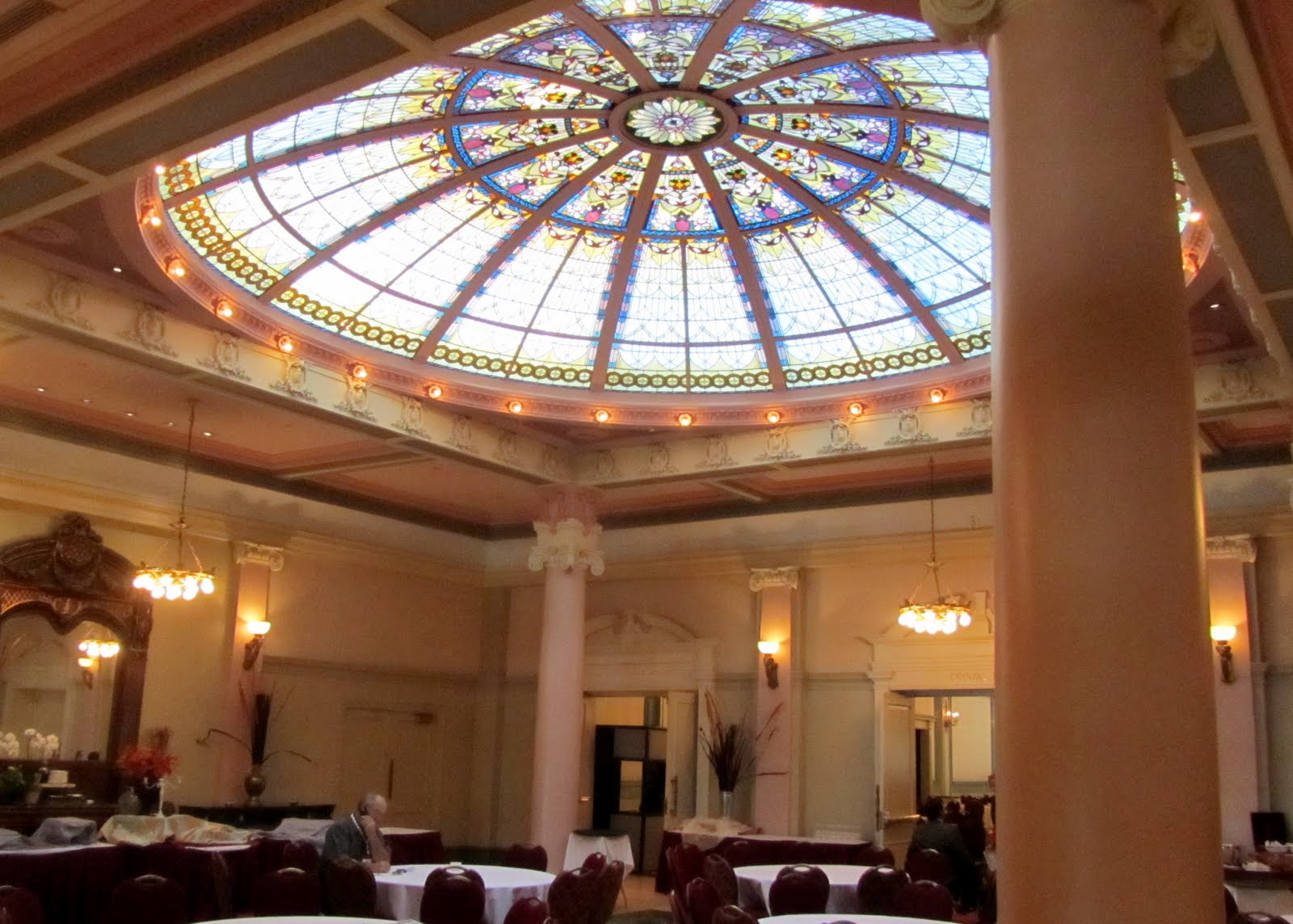
To a utilitarian peaked towers and stained glass skylights are nonsensical. Think of the maintenance. And isn't English ivy an invasive species? But then on the other hand if you are trying to sell a piece of art carved from mammoth tusks and BC jade for $76,000 then somehow a flea market on the street won't do- high ceilings and brass fixtures make a far better setting. Oh, well. On a fine autumn day I'm glad that much of Victoria was built before the world went insane. And try as they might the prophets of soulless ugliness have not been able to stamp out that human spirit that aspires to beauty. Even the activist on the corner can't hide her prettiness behind the scruffy look that is today's idea of fashion.

Wednesday, April 21, 2010

Cattle Point


There is something about the seashore that entrances me. The rhythmic lapping of the waves, the salty tang of the air, the sheer weight and power of the ocean, the knowledge that in the depths a world entirely alien to me teems with life, it's all so beautiful and strange. I was disappointed that today was cloudy, but even so Cattle Point, a rather wild place, was still beautiful. Beauty is everywhere, but it's easier for me to see in some places than others. It's my belief that when we perceive beauty we are perceiving God directly. It's not the things themselves that are God, but the beauty itself. That's why I think it's important to cultivate our sense of beauty. The things we see register through our senses, but it is our souls that recognizes beauty.
I am what's called a cradle Catholic, having been raised in a strongly Catholic home. Like most young people I went through a phase of skepticism before coming to the realization that the Church has mankinds deepest, most profound and thorough body of thought on morality, ethics, and the relationship we mortals have with eternity. If I had paid more attention to it I might have avoided some of the serious damage I have caused in my life. So when I hear of the likes of the New York Times, Christopher Hitchens and Richard Dawkins lecturing the Pope on morality, I am understandably disturbed. Hitchens and Dawkins want to arrest him, and I suppose their next step would be to put the rest of us Catholics in reeducation camps. The provocation du jour changes from time to time, but the technique of exaggeration, outright lies and misinformation, and above all the mindless, visceral anti catholic bigotry remains the same.
Do Catholics, even priests and nuns who take vows to serve Christ's flock, sometimes violate the moral teachings of the Church and commit grievous sins? Of course. It's just as the Church teaches- we are all fallible, we are all inclined to commit grievous offences. I am just as disturbed as anyone by prominent people who call themselves Catholic- Nancy Pelosi would be a good example- and then turn around and do their utmost to promote laws that allow the killing of babies. It is despicable for a person entrusted with the priesthood to deliberately corrupt a child, but the 50 million abortion deaths in the US since Roe vs Wade is monstrous. And keep in mind that the Church is reviled by the New York Times both for having a culture of permissiveness regarding child abuse (which it doesn't) and for opposing 'a woman's right to choose.' (a euphemism for killing unborn children) In fact the Church has been opposed to abortion since the days of the apostles when Christians routinely rescued unwanted children from dunghills where they were left for dogs and vultures to eat. It is part and parcel of the fundamental reverence for life taught by all the Church teachers and thinkers to condemn such practices. One of the most enduring Christian images is of Mary and the infant Jesus, a favourite subject of all the great artists in our tradition. The family, the child, no matter how humble is precious to the Church.
If Hitchens and Dawkins called for the arrest of the executive of Planned Parenthood and Nancy Pelosi as enablers for the holocaust of our children it would be understandable.
But still, I would say that the remarkable ignorance of the general public, and even most Catholics, regarding the teachings and insights of the Church is largely the Church's fault. With all the possibilities of the media that have come into existence in the last century it has failed to realize that the pulpit no longer has the power to influence it once had. Movies, radio, TV, and now the internet present huge opportunities which the Church has been slow to utilize. But one could go all the way back to the 16th century when the printing press came into use. From then on the Church lost its monopoly on the dissemination of Christian doctrine because more and more people could read the bible, often newly translated into the vernacular, for themselves and make up their own minds. A new class of interpreters came forward, like Martin Luther, John Calvin, John Wesley and many more who led movements in different directions. For opportunists like Henry VIII they provided all the excuse he needed to seize the Church's considerable wealth.
The inability of the Church to communicate its message continues today to the point where it has become almost incomprehensible to the modern mind. What does the public, even the Catholic public, understand about the meaning of concepts like sin, grace, free will, penance, salvation? Why does the Church insist that Jesus was literally the son of God? Is Hitchens even remotely familiar with these ideas? He shows very little sign of it, and how can he disagree with something when he doesn't know what he's disagreeing about?
As for Dawkins, his claim to fame rests in his books on the primacy of the genetic code to explain the creation of life. No room for God in his thinking. And there is nothing in the logic of the genetic code to make concepts like morality meaningful. His selfish gene is only concerned with its continuance, nothing else. And if that's the case, how can Dawkins condemn any actions by anyone since they are all predetermined by DNA- by his own theology, the DNA is always right. The fact that he has yet to follow his own logic this far doesn't say much for his intelligence.
It seems to me that the New York Times, Christopher Hitchens and Richard Dawkins should try out a time honoured Catholic technique called an examination of conscience. That's where a person goes off by himself and thinks through his beliefs and actions in the light of the ten commandments, among other Christian orthodoxies. Of those commandments, the one about bearing false witness would seem to be especially appropriate.